
OLA Law Targeting ICE Begins To Sweep Across East End
A proposed law drafted by Organización Latino Americana and former State Assemblyman Fred Thiele, which seeks to foster transparency and accountability during federal immigration enforcement actions in local towns and villages, is beginning to sweep across the East End.
What the five-page resolution calls for, primarily, is the establishment of a series of procedures and training programs that would stymie the impersonation of federal officers and the adoption of local requirements for reporting enforcement activity.
It would require local police to approach those claiming to be ICE agents, who are often masked, and ask to see some form of identification, as part of an effort to hinder potential ICE impersonators. Officers then would send the information learned up the chain to local leadership.
OLA plans to meet with leaders of East End municipalities on January 26 to further discuss the proposed law.
“If we can let our community know that we understand that times are different — and I’m just, like, using these stupid euphemisms here — but if we can recognize that we have a role in all of this, for public safety, for health, for nutrition, for everything that goes along with the safety of our children, what is the role of local government in this particular context? It might be less than people really want it to be, but it has to be something,” said OLA Executive Director Minerva Perez.
And that’s where the proposed law comes into play: The intent is to carve out the space that local governments and police departments can occupy in the event of an ICE raid.
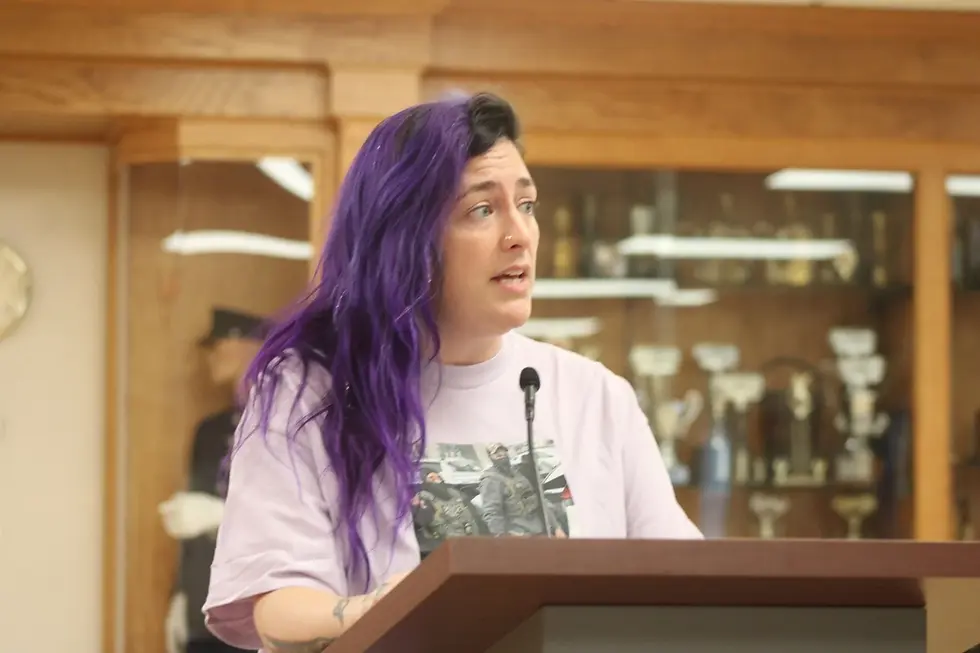
“This resolution was specifically written to be nonpartisan,” said Anita Boyer, who is part of OLA’s rapid response team. “It is not an anti-ICE statement — my shirt is — but, really, it's about public safety, which is at the forefront of everything that the rapid response is doing, and ways that, if we're protecting the most vulnerable people in the community, we are protecting everyone in the community.”
Thiele and OLA looked at how other municipalities around the country, including in San Jose, California, and Philadelphia, Pennsylvania, are responding to Immigration and Customs Enforcement, or ICE, presence when drafting the law.
But the problem, per Perez, was that the East End, with its assortment of different towns and villages and 10 different police departments, is a municipal anomaly, meaning precedent was hard to come by. This required OLA to pull together elements from several places.
“My hope is that the enactment of consensus legislation will be a peaceful and powerful catalyst to ending ICE excesses that threaten community safety and local control in our community,” Thiele said.
As it appears now, the law would see the governments that adopt the law implement protocols for gathering and preserving evidence in the event of an ICE action, techniques for interviewing witnesses and victims, methods for verifying federal identification, and procedures for working with federal agencies to confirm the identity of individuals claiming to be federal officers. A commitment to maintaining detailed records of impersonation incidents also is in the resolution.
Those found to be impersonating law enforcement officers would be criminally prosecuted, with boosted penalties if the impersonation was done in connection with another crime.
Second on the resolution is the establishment of reporting requirements for local governments, which would see police report federal enforcement actions to the offices of either the village mayor or town supervisor. This would be passed down through the government, with the intent of making it ultimately available to the public.
The legislation also calls for the creation of a community task force that each town or village board would consult on matters related to immigration enforcement.
“We are not having any faith in anything around us, so this kind of legislation … will allow towns and villages to sort of reconnect the fabric that is being just shredded right now,” Perez said. “We’ve enjoyed safety, beauty, solace, all these kinds of things, and it is being torn to shreds, and this is something that addresses that.”
To lobby for the legislation, Boyer has been popping up at town and village board meetings across the East End, starting with the Riverhead Town Board on February 18 and continuing her efforts at the East Hampton Village Board meeting on Friday, February 20.
There, she mentioned a recent experience at the Family Court in Riverhead, where she was filming someone being taken out of their car by ICE agents. On her shirt was a still photograph that she pointed to when discussing why she thinks the law is needed.
“This particular image was important to me, because it shows that the tallest, the biggest, the most heavily armed was threatening us with pepper spray,” Boyer said. “The pin was out, his thumb was on, and I fully believe that if the court police officers were not present, I would still be red in the face from having been pepper sprayed. So their presence already proved that it keeps the public safer.”
So far, Boyer has been to the Riverhead Town Board meeting and the East Hampton Village Board meeting to advocate for the law, while Perez has spoken at Shelter Island and Southold town board meetings.
At the East Hampton Village Board meeting, Mayor Jerry Larsen said he plans to meet with OLA and all other East End municipalities to discuss the law and hear what Perez intends with the law.
That said, Larsen signaled to Boyer that he was open to considering the law and said that OLA would have a sympathetic ear with him.
“I applaud OLA for having the rapid response team that they have,” Larsen said. “But what I don't like is putting civilians, like you're saying, in harm's way. I do agree it should be some sort of law enforcement response. I have reached out to the governor's office with my idea that it should be a State Police task force, or I reached out to the sheriff to see if the county would do a county task force.”
What was front of mind for the Village Board was the possibility of ICE impersonators. Village Board member Sandra Melendez said people can call 911 if someone comes to their door claiming to be ICE, and police will come to determine whether it is ICE or not.
Melendez brought the conversation back to Boyer’s experience at the courthouse in Riverhead.

“I agree that we have to do something,” Melendez said. “ICE is not following the rules, so we need PD, we need to stay to protect the people that are on the other end of it. They were not supposed to be in that court. They're not supposed to be, as per the New York State law. What happened on Wednesday shows that they're not following the rules exactly, so we as a community have to stand and protect the ones that cannot talk or the ones that are afraid. So I'm with you, and we will be working on this.”
Still to come is the meeting with East End leaders on February 26, where Perez plans to walk through the adaptability of the law, as each village or town will be responsible for the specific implementation plans. The involvement of law enforcement in the law, though, is nonnegotiable.
But before adoption, the law will go through the normal processes, town by town and village by village, with the plan being to have the law appear at a work session and then at a public hearing, prior to finalization.


Comments